 |
 |
|
 |
|
 |
|
 |
|
 |
|
 |
|
 |
|
 |
|
 |
|
 |
|
 |
|
|
|
 |
|
|

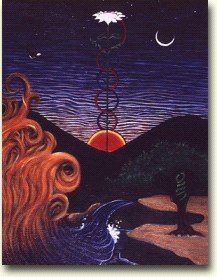 |
| The universal law of polarity balance is symbolically
represented in this figure: sun/moon, light/dark, fire/water, masculine/feminine. (Painting by Paul Cumes) |
Inward Bound’s intention is to explore the inner or healing journey into wilderness. This implies using the experience of nature as medicine and the itinerary for the trek differs vastly from most wilderness adventures. During and after these journeys the participants have profound restorative and healing experiences. Many of them who have done wilderness trips for years admit that this inner journey is quite different and even life-altering.
Trip Information and Itinerary:
The groups have always been intentionally small, highly compatible and the rich inward experience an added benefit to a superb outward adventure, where you will not only experience the plethora of game and the "Big Five" but will get to feel the extraordinary cultural and spiritual depth that is Africa.
Wilderness psychologists have become interested in the inner journey into nature. Based on their writings and the inspiration of ancient wisdom especially yoga, “Inward Bound” was formed. Inward Bound’s focus is on the inner journey into nature and this can create a special effect. This unique effect called “Wilderness Rapture” has been desribed in the book "Inner Passages Outer Journeys." This rapture occurs when one comes into contact with a greater part of one’s inner being or higher self while in the wild. The following is a summary of some of its manifestations.
|
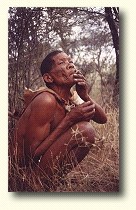 |
Before one ventures into the wild outdoors there may be a sense of uneasiness which creates the need for much preparation. Often a sense of duality is apparent. Luther Standing Bear said; “It was only when the white man came that wilderness existed.” To the Native American there was no such duality. We, however, often feel that we are “here” and wilderness is out “there.” Finally, we enter and imperceptibly become part of the wilderness and a sense of oneness and harmony supervenes.
The experience of "WIlderness Rapture" also leads to the well-described phenomenon of “re-entry depression,” which can be considered a manifestation of how potent the inner effect of the journey has been. Many participants experience a sense of loss when they return home. Paradoxically this depression occurs in the face of a demonstrable restorative effect. The re-entry depression seems to be a result of having been in an altered state of consciousness and upon the return there is a dramatic shift as one is propelled back into a normal state of awareness. The severity of the depression is directly related to the inner effect of the journey coupled with the resignation that one must now return to the frustrations of ordinary life. Often the harder the home and work circumstances, the greater the depression. With the inner-directed journey the reentry is often difficult, possibly because the techniques used on the trail facilitate an altered state of consciousness and amplify the power of the wild. Methods to deal with the phenomenon are discussed toward the end of the journey so that trailists are prepared to deal with these consequences.
 |
If we analyze the mystical effect of the wilderness we see the elaborations of some of the principles expounded by Eastern philosophies. For example being in the present moment, unconditional positive regard for one another, suspending judgment of our fellow travelers, coming closer to one’s true sense of self and being less egocentric or more humble. The ultimate goal of these philosophies is to leave the duality of everyday existence and reach the more profound state of a "oneness" experience. Even without any esoteric practices it is easy to appreciate a sense of interconnectedness of all beings and things when one has been out in nature for some time. When we allow ego to subordinate to the real self in wilderness “Wilderness Rapture” occurs. An understanding of this spiritual principle is crucial to the wilderness experience.
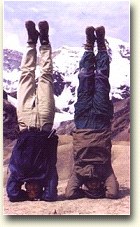 |
| Dr. Cumes and son Terry in Peru |
The following principles are utilized by Inward Bound to facilitate the inner aspect of the wilderness journey.
- An attempt is made to keep as little between the participants and nature as is feasible, bearing in mind safety and comfort. The closer we get to the earth mother, the more powerful the healing. We should not forget that nature is feminine and she can help us embrace the more internal, intuitive and creative parts of our psyche.
- Time restraints and goals (bagging peaks, running rivers) are avoided as far as practicable.
- Unless the unpredictable occurs, endurance or survival-type experiences are not encouraged.
- No knowledge of wilderness skills is required; this is provided by the staff. The energy normally required for daily tasks can be utilized in more self-restorative ways.
- Time is set aside for group interaction in the form of a “council circle” where the multidimensional facets of the experience are shared. This is done in a special way so that the process becomes a special form of group meditation.
Other eclectic techniques for going inward are utilized, including, meditation, silence, alone time, special breathing techniques,yoga, and ritual.
 |
|
"To "achieve" is to be externally oriented but to attain deeper effects, we need to let go of attachment to accomplish anything. Goal orientation and rapture are mutually exclusive in the present moment. We begin with a goal but once the intention is set, we need to let go of the possible outcome. This is the crux between balancing the inner and outer." Inner Passages, Outer Journeys |